
Why is coffee so expensive right now? October 2026
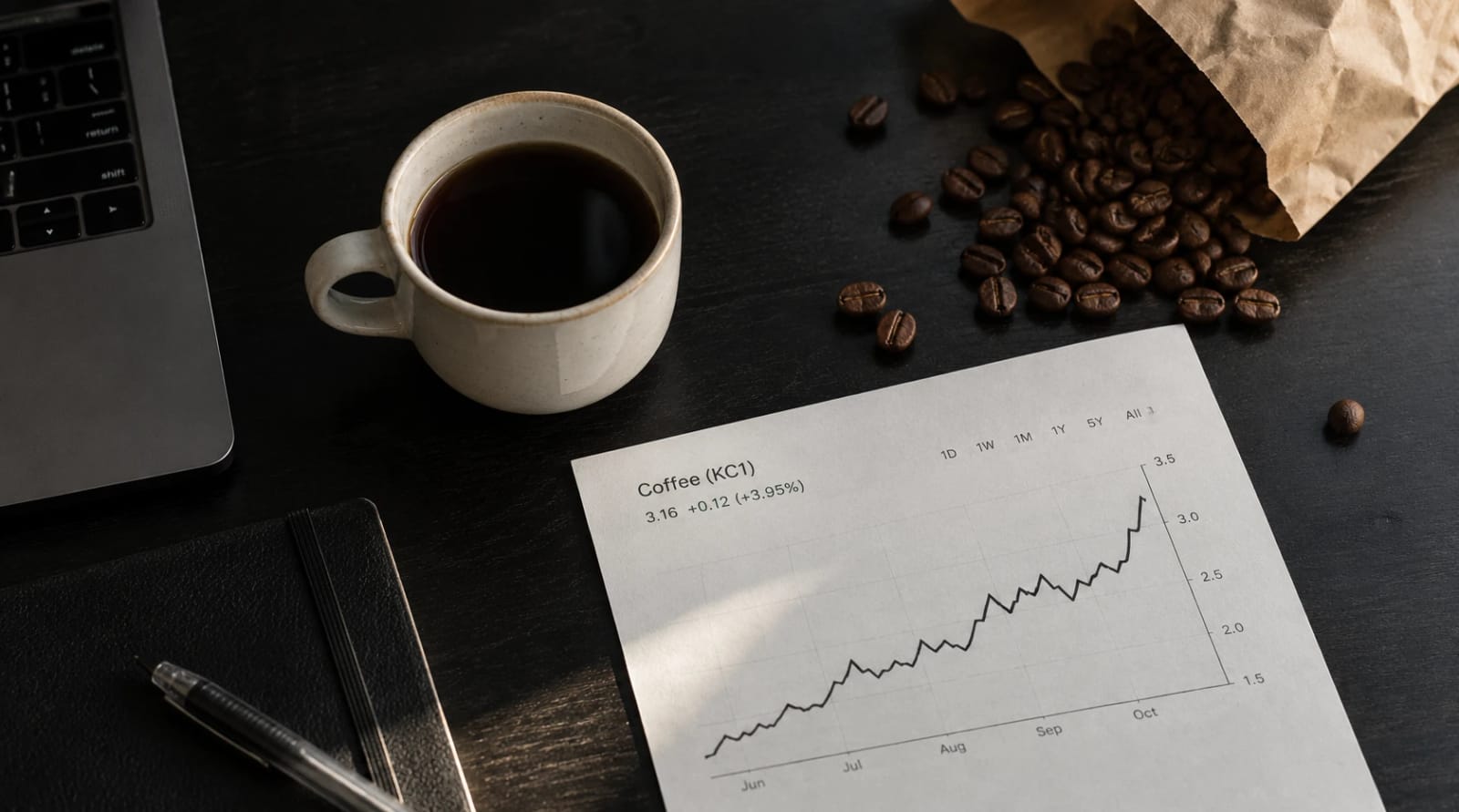
Why is coffee so expensive right now? As of October 21, 2026, arabica futures in New York trade at about US$3.16 a pound, their highest since August and up about 15% in four weeks, according to Trading Economics. The short answer: the exchange’s warehouses are nearly empty, Brazil’s currency has strengthened, and a strong El Niño threatens next year’s crop.
The longer answer matters more if you buy coffee at home, because the price on the exchange is not the price on your bag. Here is what moved, why, and what it actually means for what you pay.
What the coffee price is, and who pays it
When the news says coffee prices rose, it means arabica futures on the ICE exchange in New York, quoted in US cents per pound and known as the C price. Importers and roasters price most green coffee against it, so it sets the floor for everything, including specialty.
Specialty lots sell at a premium above that benchmark, called a differential. Specialty operates outside the futures market but follows it: “When the C market rises, everything goes up, including the specialty market,” Albert Scalla of StoneX told Perfect Daily Grind in 2025.
In September the benchmark was falling. The International Coffee Organization reports that its composite price averaged 262.18 US cents a pound that month, down 8.7% from August, as Brazil’s record harvest reached the market. Brazil’s crop agency Conab raised its 2026 estimate to 67.6 million bags on September 24, Food Business MEA reported, with arabica up 34.8% on last year.
So why is coffee so expensive again?
Then October turned. On October 19 the December arabica contract settled at US$3.157 a pound, up 3.3% on the day and about 11% in a week, The Rio Times reported from Reuters and Notícias Agrícolas. Three things did it.
- Empty warehouses. Coffee certified for delivery against the New York contract fell to 217,646 bags on September 15, the lowest since 1999, the ICO report says. It had recovered only to 240,767 bags by October 19, Reuters reported, and traders worry that Brazilian beans will not arrive and pass grading before the December contract expires.
- A stronger real. Brazil’s currency firmed to about R$5.04 to the dollar on October 19. Growers earn fewer reais for every dollar of coffee they sell, so they hold their beans back, and less coffee on offer means a higher price.
- El Niño. The US Climate Prediction Center put the chance of a very strong El Niño above 90% on September 10, the ICO notes. Brazil’s trees are flowering now for the 2027 harvest, and traders fear a hot, dry summer there. The ICO also lists drought alerts in Honduras and Nicaragua.
None of these is about this year’s coffee. They are about where it sits, what it is worth in local money, and what next year looks like.
Is there actually a coffee shortage?
No. The same ICO report estimates a surplus of 3.0 million bags for the 2025/26 coffee year, the first after four years of deficit, with world consumption down 0.8%. Global green coffee exports in August 2026 were up 15.6% on a year earlier.
A 3-million-bag surplus is less than one week of world consumption, as the ICO itself points out, so the market stays jumpy. And not every origin is up: Colombia’s 2025/26 output fell 15% to 12.65 million bags, its growers’ federation said, as reported by Perfect Daily Grind.
So there is plenty of coffee, just not graded and sitting in the right warehouse in time. That moves the nearby price far more than the price of coffee a year out: on October 19 the March 2027 contract settled at about 302 cents, 13 cents below December.
What it means for the coffee you buy at home
The price on the exchange reaches your bag late and only in part. A UN Food and Agriculture Organization report cited by Perfect Daily Grind found that up to 80% of a green coffee price rise is passed to consumers within 11 months in the EU and 8 months in the US. The same lag works on the way down.
That is why you are still paying for last year’s spike. Arabica was about 23% higher a year ago than it is today, per Trading Economics, yet US roasted coffee prices in September 2026 were 7.2% above September 2025, in the Bureau of Labor Statistics’ consumer price index released on October 14. Those are bags bought at 2025 prices and sold in 2026.
In Europe the pressure has eased. Eurostat’s price index for coffee, tea and cocoa stood at 100.0 in August 2026, 1.4% below its August 2025 peak, per Trading Economics, and the European Central Bank wrote on October 20 that coffee, which drove food prices up in 2025, was contributing negligibly to food inflation by September 2026.
If you buy from a roaster in the United States, tariffs are now coming out of your price rather than going in. Green coffee was exempted from the 2025 import tariffs on November 14, 2025, the Supreme Court ruled those tariffs unlawful on February 20, 2026, and refunds go to importers first, Royal Coffee explains. By July, Royal and Cafe Imports were passing refunds on to roasters, Sprudge reported, and on October 20 Blueprint Coffee in St. Louis said it is handing its refunds back to wholesale partners and customers as coupons.
For a roaster, the beans are one cost in a bag, alongside roasting, packaging, shipping and rent. A café may be serving beans bought months earlier while the roaster already has future shipments fixed, as Achilles Coffee Roasters puts it, so a 15% jump in futures over four weeks will not show up as 15% on your next bag. If futures stay above US$3 into 2027, expect roasters to adjust then, not next week.
Three ways to pay less for better coffee
- Compare by the kilo, not the bag. Bags come in 200 g, 250 g, 340 g and 12 oz, and the cheaper bag is often just the smaller one. A price per kilo puts them side by side.
- Buy what you will actually finish. The most expensive coffee is the one you don’t enjoy and leave in the cupboard. Find out what you like before you pay more for a special bag.
- Don’t stock up. Roasted coffee is a fresh product. A bag bought in October to beat a price rise in March is a stale bag in March.
See the price per kilo on Coffi
Every coffee on the Coffi Marketplace shows its price per kilo next to its price, as of October 2026, and you can sort the whole marketplace by price per kilo, low to high, to see which roasters give you the most coffee for your money.
Taste Match gives each coffee a personal match score, built from a few questions about what you like, so the bag you pay more for is one you are likely to enjoy. It’s free, and you don’t need an account.