
How to read a coffee bag: what each label means
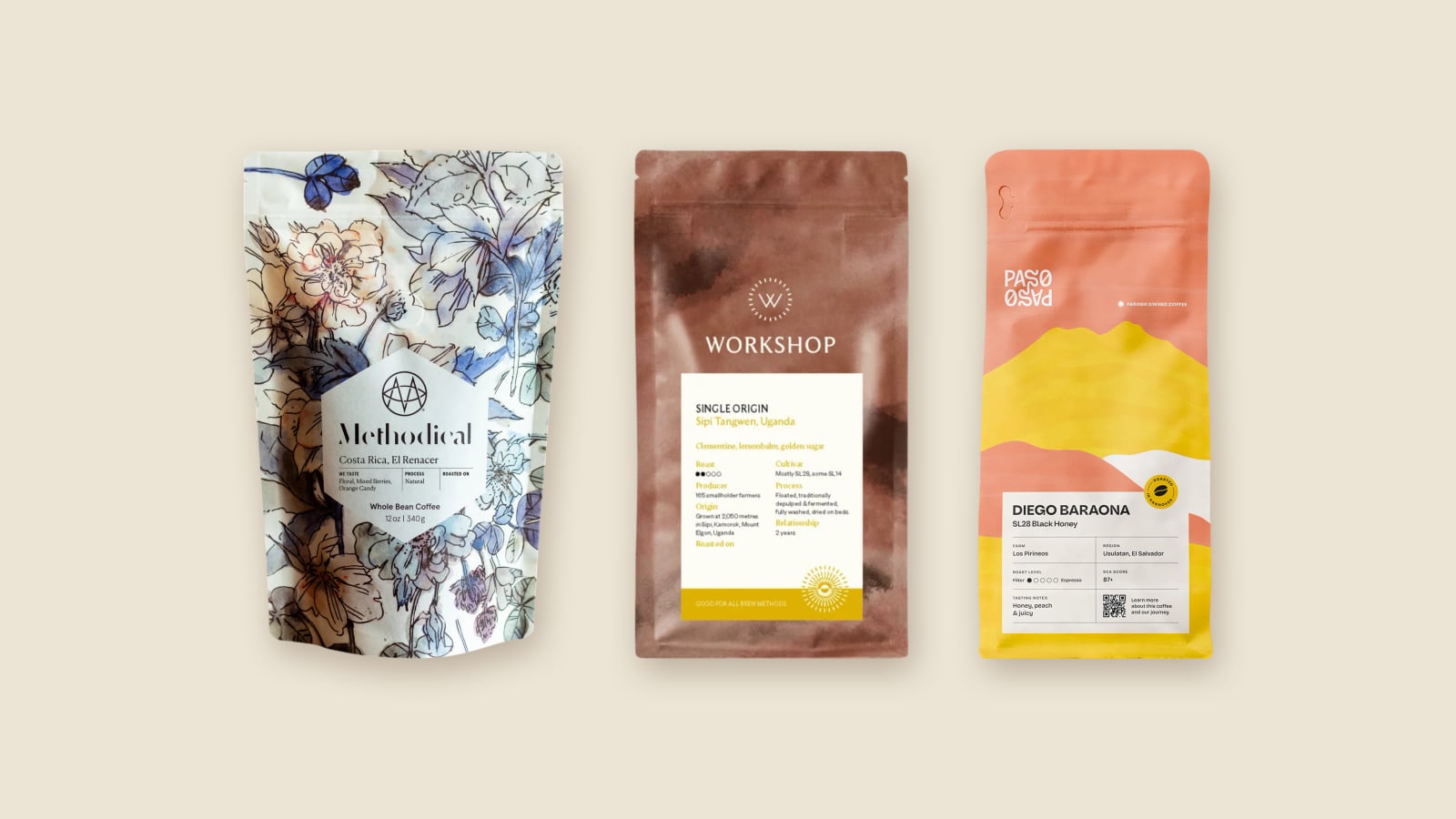
To read a coffee bag, start with the roast date, then look at where the coffee was grown, how it was processed and the tasting notes. Those four lines tell you how fresh the coffee is and what kind of cup to expect, before you open the bag.
A specialty bag can look like a wall of jargon: a farm name, a number in meters, a word like “natural” or “black honey”. Here’s what each line means, and the one thing no label can tell you.
What does the roast date on a coffee bag mean?
It’s the day the beans came out of the roaster, and it’s the most useful date on the bag. Supermarket coffee usually shows a best-before date instead, which tells you how long the coffee can sit on a shelf, not how fresh it is.
Specialty roasters started printing roast dates in place of expiry dates partly to set themselves apart from commercial coffee, Perfect Daily Grind explains.
Coffee changes quickly once it’s roasted. Most needs a few days to rest before you brew it, and roasters’ advice on how long runs from days to weeks, as our guide to resting coffee beans explains. Count from the roast date, not the day the bag arrived.
Where was the coffee grown?
Look past the country. A country is a big place, so a good bag also names the region, and often the farm and the people who grew the coffee.
A single origin comes from one place: one country, region or farm. A blend mixes coffees from several, and Perfect Daily Grind’s guide to coffee labels points out that a blend can be excellent too.
Sometimes the name on the bag is a washing station, a mill where many small farms bring their cherries to be processed. Ordinary Speciality Coffee Roasters in Frankfurt names its natural from Burundi after one, the Mubuga washing station in Ngozi, and lists its producers simply as smallholder farmers.
Washed, natural or honey: what does the process mean?
Coffee beans are the seeds of a fruit, the coffee cherry. Processing is how the farm removes the fruit and dries the seeds, and it has a big effect on flavor, Perfect Daily Grind reports.
- Washed: the skin and fruit come off before the beans dry. Washed coffees tend to be cleaner and more acidic, with fewer aromatic compounds.
- Natural: the whole cherry dries with the seed inside. Sugars in the fruit ferment as it dries, which is a large part of why naturals tend to taste sweeter and fruitier.
- Honey: the skin comes off, but a sticky layer of fruit stays on while the bean dries. No honey is involved: the name comes from that sticky coating, Sprudge explains, and yellow, red and black honey leave more and more of it on.
Newer words on bags, such as anaerobic or lactic, describe experiments with fermentation. The most specific methods, such as thermal shock, usually come from a single farm or producer, Perfect Daily Grind noted in October 2026, so read the roaster’s description to learn what was done.
What do variety and altitude tell you?
The variety is the type of coffee plant, much as wine grapes come in varieties. Almost all specialty coffee is arabica, the species, and within it varieties such as Bourbon, Caturra and Gesha each have their own character, the Perfect Daily Grind label guide notes.
Arabica is native to Ethiopia, where its greatest genetic diversity is found, according to World Coffee Research, which keeps a catalog of coffee varieties.
Altitude is given in meters above sea level, often written masl. Higher farms are usually cooler, so the cherries ripen more slowly, which gives the beans more time to develop complex flavors and makes them denser, as Perfect Daily Grind explains.
But the real cause is temperature, not height, so altitude compares best within one region. Farms in Brazil’s Cerrado Mineiro sit between just 800 and 1,300 meters and still have ideal temperatures for coffee, the same article notes.
Are tasting notes added flavors?
No. When a bag says cherry, rooibos and red apple, those are flavors the roaster tasted in the coffee itself. Nothing is added.
Coffee tasters share a vocabulary for this: the Coffee Taster’s Flavor Wheel, made by the Specialty Coffee Association and World Coffee Research. It starts with broad words such as fruity at the center and gets more specific toward the edge, and it’s built on a lexicon of 110 attributes of flavor, aroma and texture.
Treat the notes as a direction, not a promise. As Seattle Coffee Gear’s guide puts it, your brew method, grind, water and palate all change what you taste.
What about roast level and brew method?
Light roasts bring out fruit and acidity, dark roasts bring out flavors from the roasting itself, and medium roasts sit in between, according to the Perfect Daily Grind label guide. The names vary from roaster to roaster, so compare roasts within one roaster rather than across them.
Many bags also say what the coffee is roasted for. Espresso roasts tend to be darker than filter roasts, the same guide adds, and an omni roast is meant for both. Wildkaffee in Garmisch-Partenkirchen, for one, roasts its new Kenya Kiandu AA light and lists hand filters, the V60 and the Chemex as ideal for it.
How to read a coffee bag before you buy
- Find the roast date, and count the days since.
- Look for the region and producer, not only the country.
- Check the process: washed, natural, honey, or a farm’s own experiment.
- Read the tasting notes as a direction, not a promise.
What a coffee bag can’t tell you
A label tells you what a coffee is. It can’t tell you whether you’ll like it, which is why a new bag still feels like a bet.
That’s the part Coffi helps with. In the Coffi app, snap a photo of any coffee label, and Coffi finds the coffee, brings in its details and shows how well it fits your taste. When a coffee isn’t in Coffi yet, the scanner says so instead of guessing.
Taste Match gives every coffee a personal score from 0 to 100%, built from what you drink, rate and assess, or from a few questions if you’re new. It’s free.
On the Coffi Marketplace, each coffee page lists what a good bag does, where the roaster provides it: farm, producer, region, altitude, variety, process and tasting notes, next to the price per kilo.
To taste what processing does, try one of each, all on Coffi as of November 4, 2026, with notes as the roasters describe them. Workshop in London roasts Sipi Tangwen from Uganda fully washed, with notes of clementine, lemon balm and golden sugar. Three Marks Coffee in Barcelona roasts Santa Clara from Brazil as a natural: almond, apricot and vanilla.
Paso Paso in Hanover roasts Diego Baraona’s SL28 from El Salvador as a black honey, its cherries depulped without water and dried in thick piles on shaded beds, with a note of fresh peach. Wildkaffee’s Kenya Kiandu AA is part SL28 too, and washed, so you can taste one variety grown in two places and processed two ways.
Moxie in Phoenix, Arizona, adds two more: a washed Geisha from Marysabel Caballero and Moises Herrera in Honduras, and ALO Morkie from Ethiopia, an anaerobic natural with notes of lime, pomegranate and purple fruit.